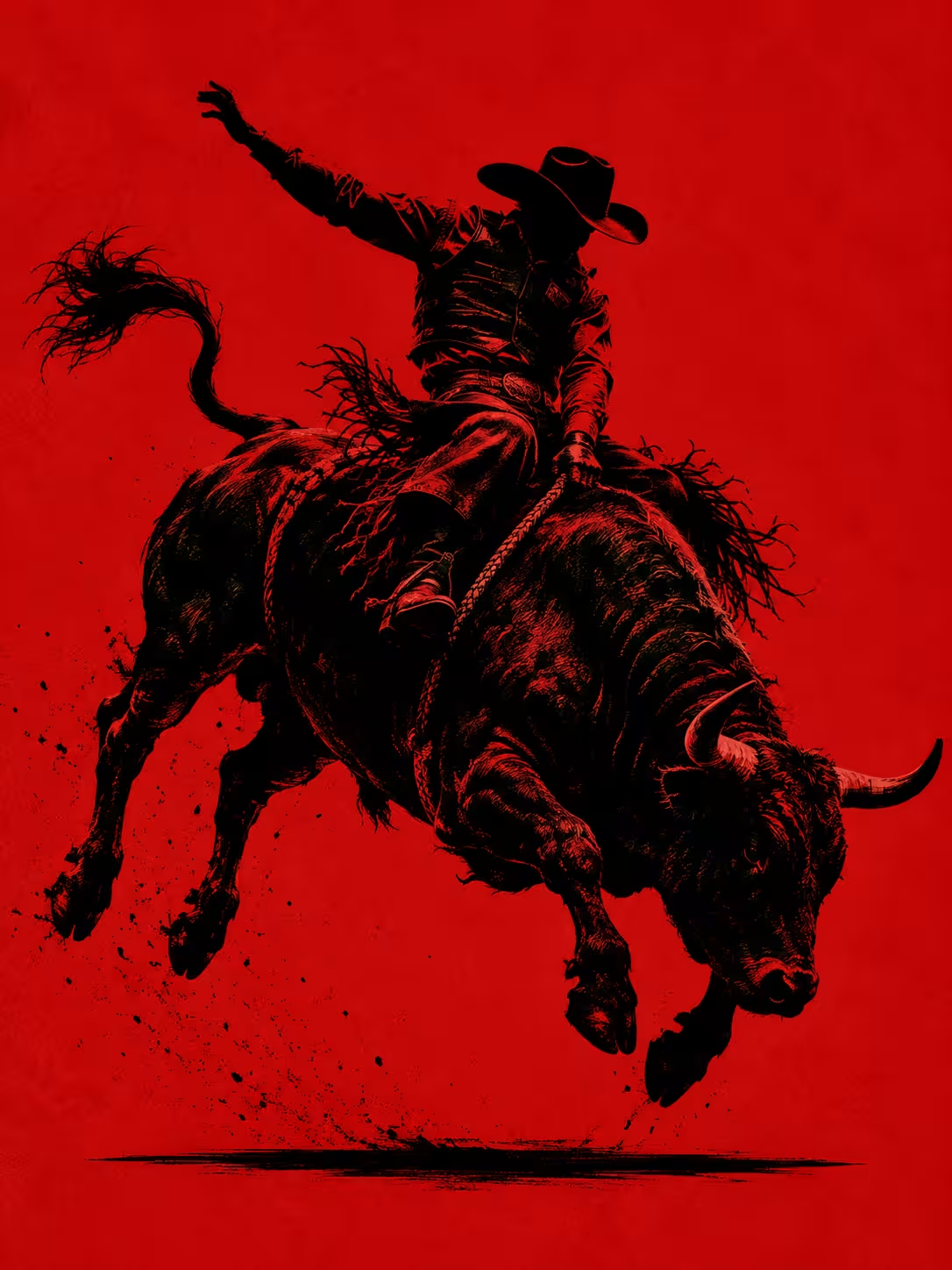
WESTERN RODEO POSTER — COWBOY RIDING A BUCKING BULL
Create a striking, ultra-detailed Western rodeo artwork featuring a cowboy riding a violently bucking bull, rendered as a dramatic, nearly solid-black silhouette against a rich, deep crimson-red background.
The image should combine the visual impact of vintage Western screen-printing, high-contrast silhouette illustration, distressed ink textures, and dynamic rodeo action photography. The result should feel bold, rugged, powerful, and timeless, like a premium cowboy apparel graphic or an iconic rodeo event poster.
1. CANVAS AND COMPOSITION
Aspect ratio: 3:4 vertical portrait.
Resolution: 1200 × 1600 pixels or higher.
Style: monochromatic silhouette artwork, Western graphic design, high-contrast screen print.
Primary colors: deep crimson red and pure black.
Composition: one large central cowboy-and-bull silhouette.
Background: uninterrupted crimson-red field.
Camera angle: low, dramatic three-quarter side view.
Lighting: strong backlighting that transforms the subjects into nearly solid-black silhouettes.
Finish: subtle distressed ink texture with sharp, expressive contours.
Position the combined cowboy and bull centrally, occupying approximately 70–80% of the canvas width and 65–70% of its height.
Leave generous empty red space above the cowboy's hat and beneath the bull's legs. The overall composition should feel balanced but energetic, with the animal's movement creating a strong diagonal visual flow.
Do not add any text, logos, borders, watermarks, or decorative elements.
2. BACKGROUND — DEEP CRIMSON RED
Fill the entire canvas with a saturated, dark crimson-red background.
Use a rich, uniform red similar to vintage rodeo posters, traditional Western screen printing, and bold red-and-black graphic artwork.
Introduce only extremely subtle tonal variation and fine printed-paper grain. The background should remain visually clean, uninterrupted, and almost completely flat.
The black silhouette must contrast sharply against the red, producing an instantly recognizable, dramatic image.
Avoid bright scarlet, orange-red, pink, gradients that are too noticeable, landscape scenery, arena structures, crowds, ropes, or additional objects.
3. MAIN SUBJECT — POWERFUL BUCKING BULL
Create an enormous, muscular rodeo bull captured in an explosive bucking movement.
The bull should be oriented predominantly toward the right side of the frame, with its head lowered aggressively and its body arched in a powerful twisting motion.
Its massive torso should dominate the central and lower portions of the composition.
Bull anatomy and pose
Broad, muscular shoulders and thick neck.
Large, heavy body with a curved back.
Head lowered toward the lower-right.
Two clearly defined horns extending outward from the head.
One horn curving prominently toward the right edge.
Powerful front legs bent and lifted off the ground.
Rear legs extended downward and backward in an energetic kicking motion.
Tail extended dramatically toward the left, with a tufted tip.
Neck muscles and shoulder contours emphasized through irregular silhouette edges.
The bull must look anatomically plausible, heavy, powerful, and physically capable of explosive movement.
Its body should be twisted and arched, with the front end plunging downward while the rear rises upward. This uneven posture should communicate the violent energy of a classic rodeo buck.
Render the animal almost entirely in solid black, preserving recognizable anatomy through its external contour and carefully placed crimson-red negative-space details.
Fur and texture
Introduce selective jagged strokes and irregular edges around the shoulders, head, tail, and back to suggest coarse fur and motion.
Use a few thin red cutouts inside the black silhouette to imply the separation of muscles, hair, and folds of skin.
Keep these details restrained. The animal must remain a powerful, readable black shape rather than becoming a highly detailed realistic painting.
4. COWBOY RIDER — WESTERN SILHOUETTE
Position a cowboy on the bull's back, slightly above the center of the canvas.
The rider should be leaning backward and upward in response to the bull's violent bucking movement, with a strong, recognizable Western rodeo posture.
Head and hat
Give the cowboy a classic wide-brimmed Western cowboy hat.
The crown should be clearly defined, with a slightly curved brim and a distinctive silhouette that makes the rider immediately recognizable.
The cowboy's face should remain completely obscured by shadow.
Upper body
The rider's torso should lean diagonally backward, with the shoulders raised and the body twisting to maintain balance.
One arm should extend downward and outward, holding or reaching toward the rodeo rope.
The opposite arm should be raised or partially extended for balance, with the elbow bent naturally.
Use rugged Western clothing, suggested by the silhouette of a long-sleeved shirt, vest, or rodeo jacket.
Lower body
Position the rider's legs naturally around the bull's back, with the thighs gripping the animal and the boots projecting outward.
The cowboy's posture must communicate the struggle to remain mounted as the bull bucks violently beneath him.
Maintain anatomically plausible proportions, realistic joint positions, and clear separation between the rider and the bull wherever necessary.
The entire rider should be nearly solid black, with a few tiny crimson-red gaps suggesting clothing folds, rope details, and separation between the arm and torso.
5. DYNAMIC MOVEMENT AND VISUAL ENERGY
The scene must feel frozen at the most dramatic instant of a rodeo performance.
Emphasize the contrast between the bull's powerful downward head movement, elevated rear body, kicking legs, and the cowboy's backward-leaning torso.
Use jagged silhouette details around the bull's mane, tail, shoulders, and the cowboy's clothing to suggest rapid movement.
Introduce a few subtle, sharp black strokes near the animal's outline to evoke flying dust, kicked-up debris, and motion.
Keep these marks integrated into the main silhouette, especially near the bull's tail and shoulder region.
Avoid excessive speed lines, comic-book effects, or floating particles that make the image appear cartoonish.
6. BLACK SILHOUETTE AND NEGATIVE-SPACE TECHNIQUE
Render the cowboy and bull primarily as a single, unified black silhouette.
Use solid, deep black with minimal internal detail.
The silhouette should have strong, clean contours, interrupted only by selected red negative-space marks that define important anatomical features.
Use negative space sparingly to reveal:
The cowboy's arm and torso separation.
The outline of the cowboy's hat.
The bull's horns and lowered head.
Selected fur strands and shoulder contours.
The shape of the legs and tail.
Small distinctions between the bull's body and the rider.
The image should remain immediately recognizable when viewed from a distance or reduced to a small thumbnail.
Avoid gray shading across the subjects, excessive gradients, photographic color, or visible facial details.
7. GROUND SHADOW
Beneath the bull, near the lower center of the composition, add a thin, elongated horizontal black shadow.
The shadow should resemble a narrow, flattened oval or an irregular brushstroke extending beneath the animal's hooves.
Position it slightly below the lowest leg, leaving a small separation that suggests the bull is suspended in mid-buck.
Use a solid-black shape with tapered ends and a slightly organic contour.
The shadow should be understated and must not resemble a horizon line or landscape.
8. GRAPHIC STYLE AND SURFACE FINISH
Combine the aesthetics of:
Vintage Western rodeo posters.
Minimalist black-and-red screen printing.
High-contrast cowboy silhouette illustrations.
Rugged Americana graphic design.
Distressed ink artwork.
Premium Western apparel graphics.
Use expressive contour details around the animal's fur, tail, horns, and the rider's clothing.
The black shapes should feel bold and slightly organic, as though created by a skilled illustrator using ink and a brush.
Preserve a strong, uninterrupted red background and a restrained two-color palette.
The final artwork should feel authentic, dramatic, and professionally art-directed rather than overly polished or computer-generated.
9. LIGHTING AND RENDERING
Although the image is a silhouette, construct the subjects with realistic anatomy and believable physical proportions.
Imagine a powerful studio backlight behind the bull and rider, producing a deep-black foreground silhouette against the red backdrop.
Use precise silhouette edges, controlled negative space, and subtle texture variation.
Prioritize strong visual readability, accurate animal anatomy, realistic cowboy posture, and a compelling overall outline.
Render at high resolution with sharp edges, clean separation between the subjects and background, and minimal visual noise.
10. NEGATIVE PROMPT
Photorealistic colored bull, brown cowboy hat, visible facial features, multicolored clothing, gray gradients, blue background, orange background, arena, spectators, fences, mountains, desert landscape, text, typography, logos, watermark, decorative border, multiple bulls, multiple cowboys, extra limbs, malformed horns, unrealistic bull anatomy, broken legs, duplicated body parts, floating rider, unnatural pose, excessive dust clouds, cartoon illustration, comic-book style, low resolution, blurry silhouette, pixelated edges, cluttered composition, glossy 3D rendering, metallic reflections, excessive highlights, complex scenery, unwanted objects.
FINAL OUTPUT
A powerful, high-contrast Western rodeo poster featuring a nearly solid-black cowboy in a wide-brimmed hat riding a muscular bull in mid-buck, set against a uniform deep crimson-red background.
The bull faces right with its head lowered, horns extended, front legs lifted, rear legs kicking, and tail streaming left. The cowboy leans backward to maintain balance. A narrow black ground shadow anchors the scene beneath the animal.
The final result should closely reproduce the reference image's minimalist composition, dramatic silhouette, intense red-and-black palette, rugged Western aesthetic, and striking negative-space design.
Generated using ChatGPT.