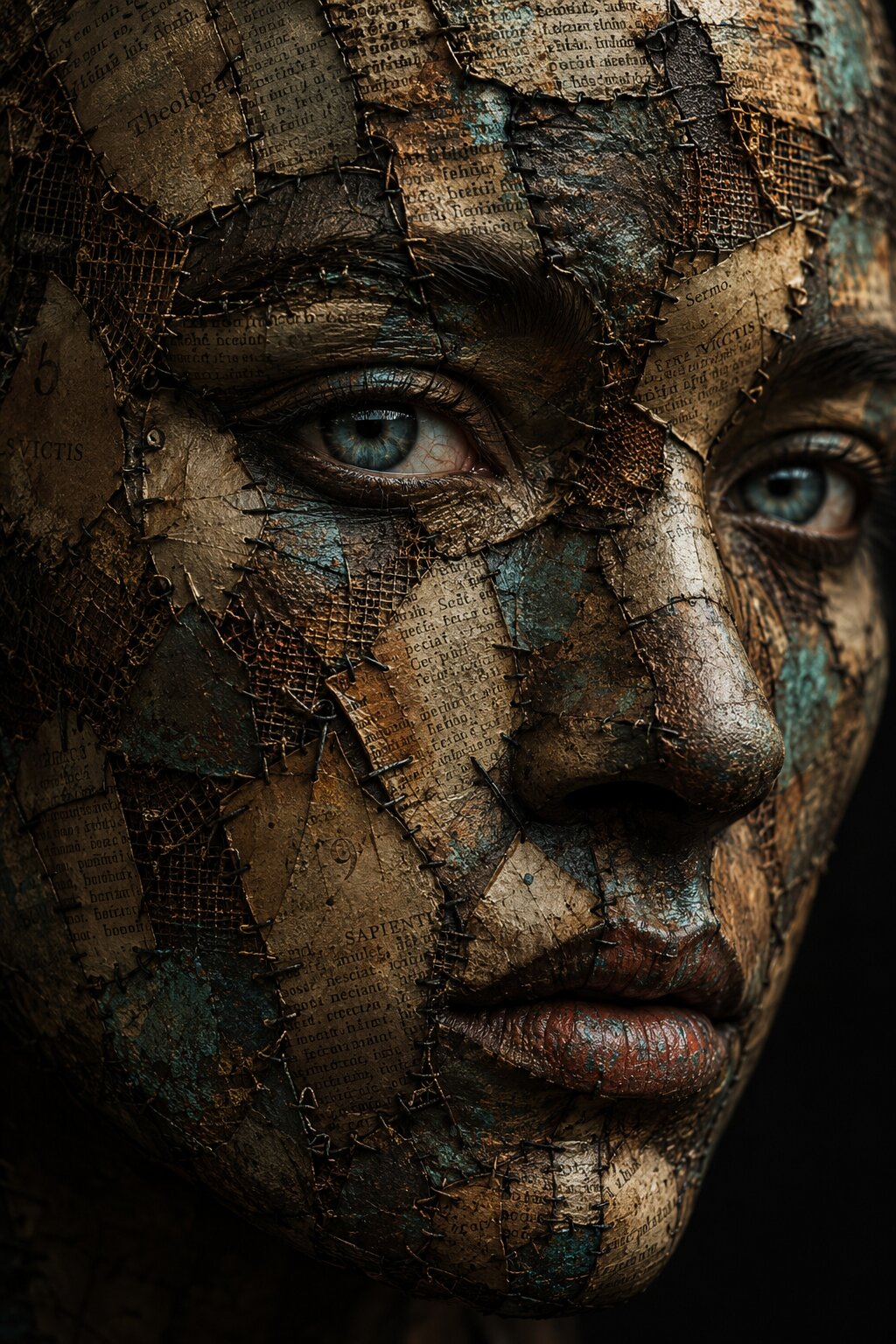
Stitched Manuscript Face
What if memory could take human form? 🧵📜 A face stitched together from forgotten manuscripts, rusted metal, worn fabric, and fragments of time—where every tear, thread, and scar tells a story that refuses to be forgotten.
Create an ultra-detailed hyperrealistic close-up portrait of a mysterious human face reconstructed from stitched fragments of ancient manuscripts, weathered parchment, rusted metal mesh, and woven textile textures. The portrait should appear as if memory itself has physically manifested into a human form.
The face is composed of hundreds of irregular torn pieces of aged paper containing faded Latin text, philosophical writings, forgotten records, symbols, and fragmented typography. These parchment fragments are sewn together with visible coarse stitches, dark thread, and rough hand-sewn seams. Between the paper pieces, intricate woven metallic mesh and textured fabric form the underlying structure of the skin, creating a haunting fusion of humanity, memory, and decay.
The skin should resemble layered archival materials rather than flesh, featuring:
- torn manuscript pages
- weathered parchment
- oxidized copper patina
- rusted steel mesh
- woven burlap textures
- stitched seams
- frayed edges
- cracked surfaces
- aged paper fibers
- distressed leather textures
- embroidered repairs
- visible thread intersections
- subtle corrosion
- layered collage construction
The eyes should remain intensely realistic and deeply emotional, with piercing blue-green irises sharply contrasting the decayed materials surrounding them. The gaze should feel ancient, wise, melancholic, and introspective.
The portrait should evoke themes of:
- memory
- identity
- time
- forgotten knowledge
- impermanence
- restoration
- human fragility
- resilience
- archaeology of consciousness
Composition
Extreme close-up portrait.
Only the face should dominate the frame.
The subject fills nearly the entire composition.
Crop tightly around the forehead, cheeks, eyes, nose, and lips.
Slight three-quarter angle.
Cinematic framing.
Shallow depth of field.
Eyes perfectly in focus.
Background almost completely dark.
Lighting
Use dramatic cinematic lighting with:
- soft Rembrandt lighting
- subtle rim lighting
- low-key illumination
- warm highlights
- deep shadows
- volumetric atmosphere
- realistic reflections in the eyes
- museum-quality portrait lighting
Color Palette
Primary tones:
- aged parchment beige
- oxidized teal
- rust brown
- charcoal black
- antique bronze
- weathered copper
- desaturated cyan
- dark umber
- faded sepia
Maintain muted earthy colors with subtle teal highlights.
Texture
Extremely high texture fidelity.
Macro-level detail.
Visible paper fibers.
Embossed typography.
Raised stitching.
Thread tension.
Metal corrosion.
Woven fabric intersections.
Fine cracks.
Weathered edges.
Aged material realism.
Tactile surfaces.
Hyperreal material detail.
Style
Hyperrealism.
Dark fantasy realism.
Surreal portraiture.
Mixed-media collage.
Archaeological aesthetic.
Wabi-sabi.
Fine art photography.
Contemporary conceptual art.
Museum installation quality.
Award-winning digital art.
Behance feature quality.
ArtStation masterpiece.
Camera
Medium format camera.
100mm macro lens.
f/2.8 aperture.
Ultra-sharp focus.
HDR.
Photorealistic rendering.
8K resolution.
Extreme detail.
Global illumination.
Physically based rendering.
Volumetric lighting.
Subsurface scattering.
Maximum realism.
Masterpiece.
Negative Prompt
smooth skin, plastic skin, clean face, modern makeup, smiling expression, cartoon, anime, glossy materials, low detail, low texture, blurry eyes, bad anatomy, duplicated features, extra eyes, extra nose, low resolution, CGI appearance, oversaturated colors, soft textures, watermark, logo, text overlay, low contrast, flat lighting, poorly stitched materials, unrealistic paper textures, deformed face, cropped eyes, low quality.