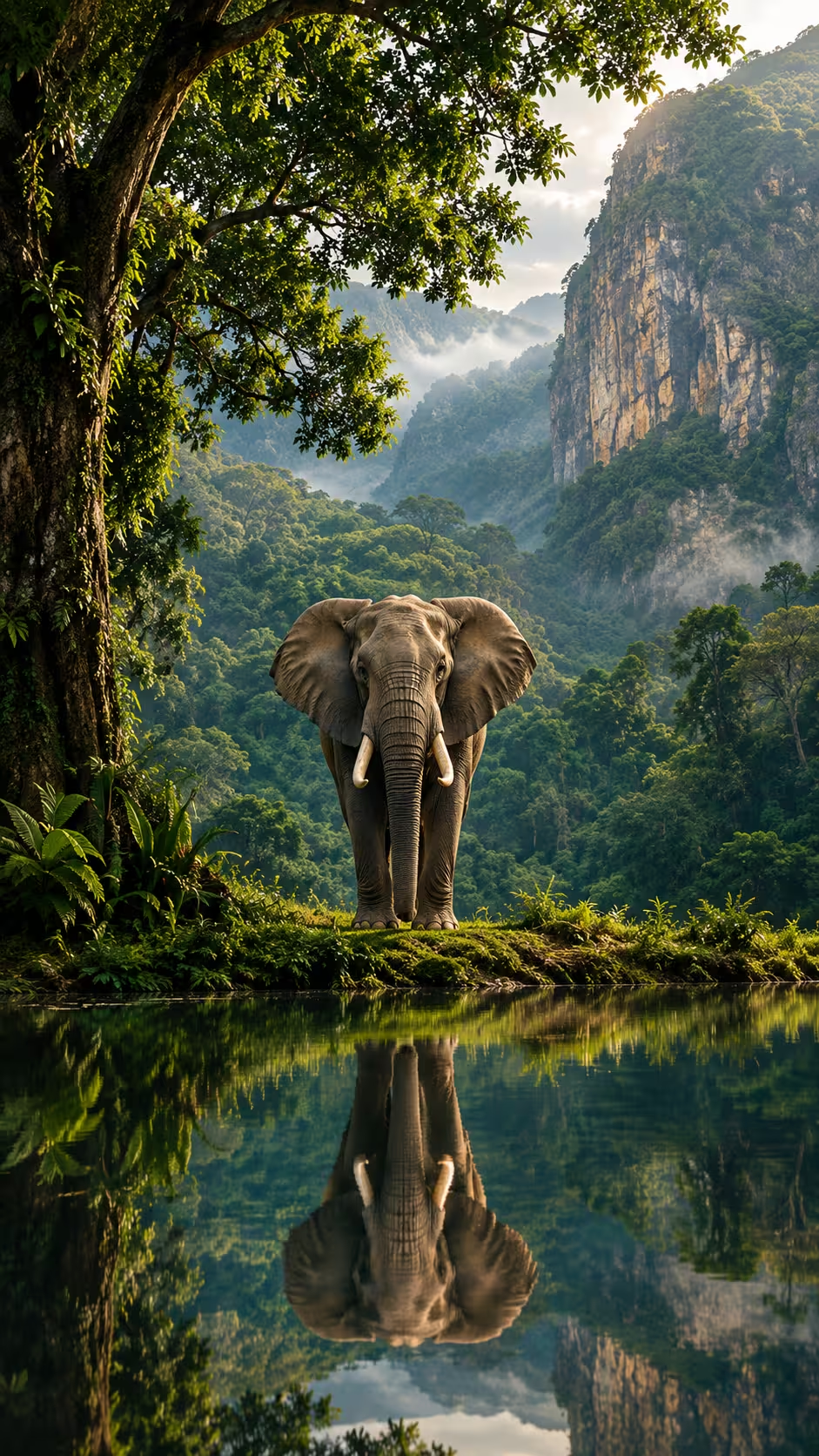
majestic African elephant
Create an ultra-realistic, breathtaking wildlife photograph of a majestic African elephant standing at the edge of a perfectly calm mountain lake in a lush, tropical forest valley. The elephant faces directly toward the camera, with its reflection mirrored almost perfectly in the still water below.
The scene should feel peaceful, majestic, mysterious, and cinematic, combining premium wildlife photography, breathtaking natural landscapes, atmospheric depth, and exceptional photorealism.
1. CANVAS AND COMPOSITION
Aspect ratio: 9:16 vertical portrait.
Resolution: 1080 × 1920 pixels or higher.
Style: Photorealistic wildlife photography, cinematic nature landscape.
Main subject: One adult African elephant.
Environment: Dense green forest, towering cliffs, and a reflective mountain lake.
Color palette: Deep emerald green, forest green, muted teal, warm gray, and natural golden-beige highlights.
Position the elephant precisely in the horizontal center of the frame, standing on a narrow strip of moss-covered ground at the edge of the lake.
The elephant should occupy approximately 20–25% of the image height, allowing the surrounding landscape to dominate the composition.
Create a strong vertical composition with the elephant and its reflection forming a symmetrical visual axis through the center of the image.
The upper half should emphasize the towering forest canopy, distant cliffs, and atmospheric mist. The lower half should emphasize the dark, mirror-like water and the elephant's reflection.
2. MAIN SUBJECT — AFRICAN ELEPHANT
Depict a majestic adult African elephant (Loxodonta africana) standing calmly and facing directly toward the camera.
The elephant should have anatomically accurate proportions, a broad forehead, powerful shoulders, sturdy legs, large ears, a long trunk, and two naturally curved ivory-colored tusks.
Head and facial details
Broad forehead with realistic skin folds.
Two large, fan-shaped ears extended outward.
Deep-set, naturally positioned eyes.
A long, vertically hanging trunk with detailed wrinkles.
Two ivory-colored tusks curving gently upward.
Realistic folds and creases across the trunk and cheeks.
Subtle variations in gray, taupe, and warm beige skin tones.
The trunk should hang naturally between the tusks, almost reaching the elephant's front legs.
Keep the ears approximately symmetrical while preserving natural anatomical differences.
Skin texture
Render the elephant's skin with extraordinary detail.
Include:
Deep wrinkles across the trunk.
Fine creases around the eyes.
Rough, weathered skin texture.
Subtle dust and natural discoloration.
Soft highlights along the forehead and ears.
Gentle shadows beneath the trunk and jaw.
Use realistic lighting to reveal the elephant's three-dimensional form without making the skin appear plastic or excessively rough.
The elephant should look peaceful, dignified, and naturally integrated into the environment.
3. POSITION AND GROUND
Place the elephant on a narrow, slightly elevated strip of dark green moss and grass at the water's edge.
The ground should extend horizontally across the middle-to-lower section of the frame.
Include subtle vegetation, damp soil, tiny plants, and natural irregularities along the shoreline.
The elephant's four feet should rest firmly on the ground, with believable weight distribution and clear contact shadows.
The shoreline should create a clean horizontal division between the landscape above and the reflection below.
Avoid rocks or vegetation that obscure the elephant's legs.
4. PERFECT LAKE REFLECTION
The lake is one of the most important elements of the composition.
Create exceptionally calm, dark teal-green water with a highly realistic mirror reflection of the elephant, surrounding forest, and distant cliffs.
The elephant's reflection should begin directly beneath its feet and extend downward toward the lower half of the image.
Reproduce the following features in the reflection:
The broad ears.
The central trunk.
The two tusks.
The elephant's front legs.
The silhouette of its head and body.
The surrounding green foliage.
The distant cliff face.
Maintain strong vertical alignment between the real elephant and its reflection.
The reflection should be nearly symmetrical but retain subtle natural softness and faint ripples.
Use realistic water optics, subdued highlights, and gentle tonal variations to make the reflection feel photographic rather than digitally duplicated.
Keep the water dark enough to create a dramatic contrast with the elephant's lighter skin.
5. LEFT-SIDE FOREGROUND TREE
On the left side of the composition, include a massive mature tree with a thick, dark trunk extending vertically along the frame.
The tree should have rough bark, irregular contours, and subtle moss or climbing vegetation.
Its dense canopy should extend across the upper-left corner and spread toward the center of the image.
Include overlapping branches and hundreds of small, naturally shaped green leaves.
The tree should act as a dramatic foreground frame, creating a sense of scale and depth.
Allow portions of the trunk and foliage to extend beyond the image boundaries.
Keep the elephant fully visible and unobstructed.
6. UPPER FOREST CANOPY
Create a dense, lush forest canopy covering much of the upper-left and upper-center portions of the image.
Include:
Layered tree branches.
Small, detailed green leaves.
Deep emerald foliage.
Dark forest shadows.
Patches of brighter sunlit leaves.
Natural variations in green coloration.
The canopy should form an irregular silhouette against the brighter distant background.
Use realistic foliage density, with sharper leaves in the foreground and softer vegetation in the distance.
Avoid artificial patterns, repeated leaf textures, or overly saturated greens.
7. DISTANT MOUNTAIN CLIFFS
On the right side of the background, feature an enormous vertical rock cliff rising above the forest valley.
The cliff should have warm beige, muted gray, and earthy tan tones.
Include realistic geological features:
Vertical rock striations.
Weathered stone surfaces.
Irregular cracks and crevices.
Subtle mossy patches.
Soft shadows along recessed areas.
Natural atmospheric fading toward the upper distance.
The cliff should appear monumental and distant, creating a dramatic contrast against the lush green forest.
Allow the upper-right portion of the cliff to receive soft, diffused natural light.
Do not make the rock formation overly sharp or brightly saturated.
8. FOREST VALLEY AND ATMOSPHERIC DEPTH
Between the foreground tree and the distant cliff, create a vast valley filled with dense green woodland.
Use multiple layers of forest vegetation to establish depth.
The nearest forest should be dark and richly textured, while the distant vegetation becomes softer, lighter, and slightly desaturated.
Introduce subtle atmospheric haze between the tree canopy and the cliff face.
The atmosphere should feel cool, humid, and peaceful, like a remote wilderness just after early-morning mist begins to clear.
Maintain a realistic sense of scale between the elephant, the forest, and the immense cliff.
9. LIGHTING AND MOOD
Use soft, natural daylight filtering through the forest canopy.
The primary illumination should come from the upper-right portion of the frame.
Include:
Gentle highlights across the elephant's forehead and ears.
Soft golden-beige illumination along the tusks.
Subtle rim lighting on the elephant's silhouette.
Deep green shadows beneath the canopy.
Diffused light across the distant cliff.
Natural reflections on the lake surface.
Soft ambient shadows beneath the elephant.
The light should be cinematic but believable, avoiding dramatic artificial spotlights or excessive HDR effects.
Create a serene, contemplative mood that communicates the grandeur of nature and the quiet presence of wildlife.
10. CAMERA AND PHOTOGRAPHIC STYLE
Simulate a professional wildlife photographer capturing a rare moment with a high-resolution camera and a long focal-length lens.
Suggested photographic characteristics:
Straight-on frontal perspective.
Camera positioned near the elephant's eye level.
Approximately 70–120 mm full-frame equivalent focal length.
Moderate depth of field.
Sharp focus on the elephant's face and trunk.
Detailed foreground foliage.
Soft atmospheric background.
Natural perspective without wide-angle distortion.
Professional exposure and color grading.
The image should feel like a genuine photograph captured at a secluded wildlife reserve.
Avoid a miniature landscape appearance, artificial tilt-shift effects, or excessive background blur.
11. CINEMATIC COLOR GRADING
Use a refined natural color grade featuring deep forest greens and cool teal water, balanced by warm stone tones and the elephant's muted gray-beige skin.
Maintain:
Rich but natural green foliage.
Deep, clean shadows.
Soft golden highlights.
Realistic skin tones.
Dark teal reflections.
Balanced contrast.
Subtle atmospheric desaturation in the distance.
The final image should feel luxurious, peaceful, and immersive, suitable for a high-end wildlife photography print.
12. COMPOSITIONAL BALANCE
Maintain the following visual hierarchy:
The elephant's face and ears as the primary focal point.
The perfectly aligned reflection as the secondary focal point.
The massive tree on the left as a framing element.
The towering cliff on the right as a background landmark.
The lush forest valley as atmospheric context.
Preserve substantial visual space above the elephant, allowing the canopy and cliff to emphasize the scale of the landscape.
Keep the elephant vertically centered around the shoreline, with its reflection extending naturally into the bottom half.
13. NEGATIVE PROMPT
Cartoon, illustration, painting, CGI, plastic skin, incorrect elephant anatomy, Asian elephant features, malformed ears, extra tusks, missing legs, duplicated trunk, distorted feet, floating elephant, incorrect reflection, misaligned reflection, choppy water, artificial mirror effects, oversaturated greenery, fantasy landscapes, artificial lighting, excessive fog, text, logos, watermarks, people, vehicles, buildings, and cluttered composition.
FINAL OBJECTIVE: Create a hyper-realistic vertical wildlife photograph of a single African elephant standing front-facing on a narrow green shoreline, perfectly reflected in a still mountain lake. Frame the scene with a massive leafy tree on the left, a towering sunlit cliff on the right, and a deep green forest valley in the background. Preserve the image's tranquil atmosphere, natural colors, monumental landscape, and striking vertical symmetry.
Generated using ChatGPT.